Wednesday, November 5, 2014

Food Science in the News - the INFORMATION edition

Do you believe "information is power" or "ignorance is bliss"? In my opinion, it depends on whether we're talking about accurate or misleading information. I bring you two news stories which both involve providing more information to the consumer, and let you decide whether this information helps you in any way.

Food Science in the News - Information is Power
Nutritional Outlook recently posted an article describing the results of a test on different Front of Pack label formats. The International Food Information Council (IFIC) Foundation conducted a study in which they gave consumers four different packages, quizzed them on the nutrient amounts, and asked them which labeling system they preferred. Here were the options, excerpted from the Nutritional Outlook article (full article here):

"The study asked participants to look at four different packages, each featuring a nutrition facts panel as well as a unique FOP label:
1) a control version without any nutrition information on the FOP,
2) an FOP listing calories only,
3) an FOP listing calories plus nutrients to limit, and
4) an FOP listing calories, nutrients to limit, as well as nutrients to encourage.

After looking at these labels, participants were asked to identify the nutrient amounts and percent daily values per serving in each product, rate the ease at which they were able to answer those questions, and pick which product was the best choice nutritionally."

*SPOILER ALERT* the fourth option won. The key here is not just providing the information, but also answering the question, "What am I supposed to do with this information?" Information is almost always useless without context.


Food Science in the News - Ignorance is Bliss
If you haven't heard this story yet, give it time. This is just the type of story that mass media loves to jump all over-- a new tool to help consumers with their food choices, combined with the right amount of fear-tactics.
The Environmental Working Group (EWG, not to be confused with Eric Will Gymnastics aka my second home) recently published a food database which contains a scoring system for nutrition, ingredients of concern, and degree of processing. Every product in the database has an overall score, which consumers can use to find "greener, healthier and cleaner food choices." A database like this is a phenomenal tool with the potential to help consumers identify smarter choices for themselves and their families.
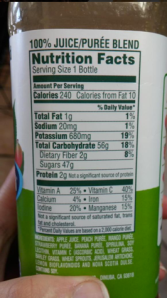
How "healthy" is this?
HOWEVER, anytime a database involves a rating system, it must also have specific criteria to remove the gray areas for assigning a one score or another. Case in point, how would you rate a vegetable smoothie that has 47g of sugar and contains ingredients with inherently high heavy metal counts (think seaweed) and pathogenic bacterial contamination (think leafy greens and E coli)? What metrics do you use to weight the severity of the "ingredients of concern"? Any ingredient also found in a yoga mat is obviously toxic, but what about salt? Sugar? Caffeine? For the degree of processing ranking, what about raw milk and the dangers associated with it's lack of processing?
I urge you to read the short rebuttal to the EWG ratings system from the Grocery Manufacturers Association (available here). A few of their most crucial points are excerpted below:

“The Environmental Working Group’s food ratings are severely flawed and will only provide consumers with misinformation about the food and beverage products they trust and enjoy. The methodology employed by EWG to develop their new food ratings is void of the scientific rigor and objectivity that should be devoted to any effort to provide consumers with reliable nutrition and food safety information. Their ratings are based almost entirely on assumptions they made about the amount, value, and safety of ingredients in the products they rate. Adding insult to injury, EWG conducted no tests to confirm the validity of any of their assumptions. Not only will the EWG ratings provide consumers with inaccurate and misleading information, they will also falsely alarm and confuse consumers about their product choices. Embedded in the ratings are EWG’s extreme and scientifically unfounded views on everything from low-calorie sweeteners to the nutritional value of organic foods.”

BOTTOM LINE

Information can be empowering, when provided in the right context. Watch out for fear tactics and overly simplified assumptions as to what constitutes "healthy food." As I tell myself every time I do a Risk Assessment for a new ingredient, CONSIDER THE SOURCE. Also, "keep an open mind, but not so open that your brain falls out."


Related Posts and Links:
I Ate the Whole Thing - Food Label Renovation perspective
FACTS and Fear - how they influence consumer perception
The Dosage Makes the Difference - Lessons from the Father of Toxicology

Help us get to 50 Likes on Facebook! https://www.facebook.com/energydrinkguide
Schedule a 1-on-1 with the GreenEyedGuide on Google Helpouts


Berkeley Passes first US Soda Tax - Food Science in the News

As reported by Nutritional Outlook, Berkeley has passed a tax on sugar-sweetened beverages.

While this could be a good pilot study for the rest of the country, what works for Berkeley may not work for other cities that aren't as notorious for being health-conscious.

Furthermore, it's unfortunate and perhaps short-sighted that Measure D does not apply to 100% fruit juices. I get that we want to encourage fruit (juice?) consumption, but I say if excess sugar consumption is bad for one's health, then all beverages with more than, say, 15g ADDED sugar per 8 ounces should be included in this tax. Note, this is where the Added Sugar Labeling format proposed by the FDA would come in handy.

This is just my opinion. I need to "pull a Hermione" and do some more research on this subject. More to come.

Read the full Nutritional Outlook article here.

Wednesday, October 15, 2014

Energy Drink of the Month -- October 2014

Food Scientists, Quality professionals and those in marketing (“Marketeers”) don’t always see eye to eye. As the Green-Eyed Guide, my goal is to challenge myself and others to expand perspectives, to try to see a situation from another’s eyes. Thus, for this month’s energy drink pick, I wanted to provide my interpretation of how three different professionals in the food industry would see the same product.

The Energy Drink of the Month for October 2014 is Rockstar Roasted with Almond Milk

 Ever since my first exposure to energy drinks (back in 2003), I wanted others to see what I saw, wanted them to know the tips and tricks I know when it comes to reading labels and deciphering the contents of an energy drink. In place of my usual written review for the Energy Drink of the Month, I present this review:

http://youtu.be/2el19xBwyls


Caffeine in Rockstar Roasted – Caffeine Informer

Rockstar Energy Drink – main site

Five Levels of Fatigue –booklet on Ebay; excerpt from Are You a Monster or a Rock Star: A Guide to Energy Drinks — How They Work, Why They Work, How to Use Them Safely

Energy Drink Guide FACEBOOK PAGE — Help push it to 100 Likes!!!
Sign up for a 1-on-1 with the GreenEyedGuide -- Google Helpouts

Wednesday, October 1, 2014

I am Beachbody - employee recognition

As the chosen "I am Beachbody" employee for October 2014, I had to make a video explaining who I am and what I do. This employee recognition is a great idea for a company as big and as rapidly expanding as Beachbody. I'm honored to be nominated, however, I knew I had to make the video a little exciting than the typical 1 minute speech in front of your workspace.

Since I had so much fun making this video, I will share it with the world!

For your viewing pleasure, in case you'd like to be a Food Scientist or Quality Specialist, or just want to know what I do for ~10 hours a day.

I am Beachbody - Who I am and What I Do

I know it's not Jenna Marbles quality, but it's my first video. It's imperfect and it's got character, like myself.

Enjoy!

--Green-Eyed Guide

Saturday, September 13, 2014

Energy Drink of the Month -- September 2014

If someone asked you to draw a Venn diagram showing energy drink consumers and loyal Jamba Juice customers, how much would those two groups overlap? If you are familiar with my Energy Drink of the Month blog posts, you know by now that all energy drinks are not created equal. Some don't fit the mold, and there are many "energy-drinks-in-disguise" at your local grocery store and/or gas station. This month's pick is dedicated to another energy-drink-in-disguise, and also to telepathy.

The Energy Drink of the Month for September 2014 is Jamba Blueberry Pomegranate.

Energy Drink of the Month Sept 2014


Have you ever looked at a food or supplement label and thought, "I wish I knew what the food scientists think about this"? Allow me to present this opportunity for you to be Mr. Spock or Dr. Xavier (your pick) and read my thoughts as I assess this product.

Read the 7 Jamba Observations-->

Wednesday, September 3, 2014

Food Science in the News: Pumpkin Spice Controversy?

I love Pumpkin Spice Lattes. For me that drink is the symbol of Fall. This is especially true since I live in Southern California and there are few other signs the season has changed.
Apparently there's some angst over how Pumpkin Spice lattes aren't made from real pumpkin. If this surprises you or even if you don't care and nothing will affect your love for PSL, check out this article:

In Defense of the Pumpkin Spice Latte

My favorite part:
Kantha Shelke, a food scientist with a background in organic chemistry and spokesperson for the Institute of Food Technologists, gets questions like this all the time. “This conversation about chemicals in food requires a certain amount of responsibility, which I think some of these elitist writers and bloggers and speakers have somehow forgotten,” she says of the backlash against pumpkin spice flavoring. “I think it’s very irresponsible to be ignorant to such a level as to lead others astray and tell them to eat chemical-free food.” After all, she says, water and salt are chemicals."

That said, Pumpkin Spice Lattes (like many things in life) are best enjoyed in moderation.

Thursday, August 21, 2014

The Making of a Quality Professional

I'm the kid who put "Eat Breakfast" on her to-do list so I'd start the day with something already checked off. I love checklists and bullet-points, and what you're about to read is a genuine enthusiasm for what I do at work. I am not fresh out of college, nor am I a seasoned professional with over twenty years in the industry.

Recently I moved from a role in Product Development to a role in Quality Assurance. This is not my first job in QA, but coming back to it after a year and a half of working on dry powder protein shake supplements, I'm noticing some key developments in my behavior.


PROBLEM SOLVING
I take the metro to work because I was having nightmares about being rear-ended on the 405. Eventually the Jellyfish Effect stopped working, and embracing the charm of traffic didn't help either.
http://www.lmakai.com/commuter-collection-necklace/
My first week of taking the train to work I was concerned by the frequency of breakdowns and delays. My commute takes four short train rides round trip. In 3 out of 5 days, at least 1 of my 4 rides was delayed due to mechanical difficulties. Statistically, that seemed like too many. This is what went through my mind:

Instead of getting perturbed by the delays, intimidated by the growing number of people waiting for the next train, or annoyed by the musk of people crammed beside me in the metro car, I was busy assessing the problem. 

Assessing the problem is the first step toward finding a solution.
http://www.zazzle.com/chemists+have+all+the+solutions+gifts


LISTENING
This might be a coincidence, but since moving to quality I believe I've become a better listener. When I was in Product Development, I was often trying to suggest answers – ingredient A works better than ingredient B; the formula tastes this way because it needs more of that, etc. Now, instead of making suggestions, I'm listening and doing a mental gap assessment – what do I know versus what do I need to know? I'm also assessing risk – what is the worst that could happen and should we try to avoid, transfer, mitigate, or accept this hazard? 

As a quality specialist, the key is not to suggest answers, but to ask the right questions.  


A DIFFERENT KIND OF FORMULATING

As a product developer I spent countless hours in the lab measuring out ingredients, enriching a formula, and tasting my creation. Now numbers are my ingredients. I recently created a spreadsheet to help me manage progress of a project I'm leading. Creating this spreadsheet was actually fun, like trying a new recipe in the kitchen. Using conditional formatting, I designed the spreadsheet so if I typed "performance" in a cell, that cell would turn blue, but if I typed "energy", the cell would turn green. 

Managing this data is on a whole different level than what I did in food science classes. It's the difference between writing a grocery list setting your fantasy line-up. 

Decisions are only as good as the data driving them.


BOTTOM LINE
As a colleague once explained to me, what makes a Quality Professional great is if they can look at chaos and see how the puzzle pieces will all fit together. I know I'm on my way...

RELATED POSTS -- A Day in the Life of a Food Scientist

Food Science in the News: Carrageenan

I recently did some digging into the safety on carrageenan in food for August's Energy Drink of the Month. In addition to being difficult to spell correctly, the problem with carrageenan is that there's a prolific amount of misinformation readily available on the internet. I found this article by the International Food Information Council: Questions and Answers about Carrageenan in Food incredibly helpful. I highly recommend it for food scientist, non-scientists and all foodies everywhere.
Enjoy: Carrageenan in Food

Monday, July 14, 2014

Energy Drink of the Month -- July 2014

It was one year ago that I first held it. I pinched it, turned it over, smelled it. Deciding that it was real, I laughed heartily and did a little dance of victory. My first book had finally been published. My quest to help people see energy drinks like I do, to explain the tricks and tips to consuming caffeine safely, and to introduce my 5 Levels of Fatigue system for picking the right product had finally materialized into a green paperback. Ten years of research, experimentation and late-night writing all in less than 200 pages.
The Goal
 Energy Drink of the Month -- A Year's Reflection
To commemorate the 1 year anniversary of what I still consider my first child, I'd like to take a look back at a year's worth of posts about the Energy Drink of the Month. Each of them is highlighted for a different reason and almost none of them matches the typical energy drink you'd hear lambasted on the news.  

Read More-->

Response to CSPI's Call for Energy Drink Warning Letters - Energy Drinks in the News

The following is a response to the Food Navigator article: "CSPI calls for warning letters on energy drinks but are the numbers accurate?" by Stephen Daniels.
That article can be read here: Food Navigator -USA article

At the time of this post, a comment I had posted was removed. That comment is shown below:

Dear CSPI, I get that you want to protect people but if energy drinks aren't proven as the cause of death, how is regulating energy drinks supposed to help? Do you want the FDA to go after every energy drink that contains more than X milligrams of caffeine per container? If so, that won't help those who consume multiple servings of a mild energy drink, or those who mix energy drinks with alcohol. Moreover, without defining the specifics of the problematic energy drinks, you group products like FRS Healthy Energy (38mg caffeine per 11oz can) right alongside products like Redline (375 mg caffeine per 8 oz can). Personally I favor education over regulation, and I'd like to see as much energy (pun intended) go into label reading and consumer education as the fervor that goes into pushing for new regulations.

-Author of "Are You a Monster or a Rock Star: A Guide to Energy Drinks -- How They Work, Why They Work, How to Use Them Safely"