Food waste is a major problem and expiration date confusion is one of the contributing factors. At a meeting of the American Chemical Society one scientist proposed smart-tags which could indicate whether food is spoiled. This innovation could alleviate some of the expiration date confusion and subsequent food waste. My only concern is that red means "fresh" and green means "spoiled".
For the full story, please see "Knowing whether food has spoiled without even opening the container" http://www.acs.org/content/acs/en/pressroom/newsreleases/2014/march/knowing-whether-food-has-spoiled-without-even-opening-the-container-video.html
For more on food waste and stability studies, see previous blog: Stability Studies - Food Scientist Life
Wednesday, March 26, 2014

Tuesday, March 25, 2014
When Granola Bars Roam Free
Perhaps it's because I'm a food scientist or perhaps it's because I
have an odd sense of humor, but I always get a kick out of products
labeled "natural." Let me share the 5 "natural" anomalies that amuse me
the most.
Green-Eyed Insight on the Most Unnatural "Natural" Food Products
Read More-->
 |
| 100% Natural Water with Added Caffeine |
 |
| This brownie is just naturally muscular, okay? |
 |
| I'm sure it would say "natural" if it had a label. |
Monday, March 17, 2014
Energy Drink of the Month -- March 2014
Planning for spring break or for bikini season? Feel sluggish and
off-schedule due to Daylight Savings Time? Want a healthy energy boost
without the sugar, the long lines at the coffee shop, or the concerned
stares of your friends and colleagues?
If so, I’ve got the perfect energy drink for you. Yes, such a thing does exist, but this product is another energy drink in disguise so you don’t have to conceal your can or worry about those “(all) energy drinks are dangerous” lectures. (I’ve had 5 of those incidents thus far this year, anyone else?)
The Energy Drink of the Month for March 2014 is FRS Healthy Energy Citrus Pomegranate.
Read more for 5 Reasons to Pick FRS Healthy Energy-->
Read more for 5 Reasons to Pick FRS Healthy Energy-->
If so, I’ve got the perfect energy drink for you. Yes, such a thing does exist, but this product is another energy drink in disguise so you don’t have to conceal your can or worry about those “(all) energy drinks are dangerous” lectures. (I’ve had 5 of those incidents thus far this year, anyone else?)
The Energy Drink of the Month for March 2014 is FRS Healthy Energy Citrus Pomegranate.
Read more for 5 Reasons to Pick FRS Healthy Energy-->
- Alternative Energy - what makes this product different than other energy drinks
- Quercetin - what it is and what it does
- Sweetened by Fruit - what the sweetener system means to the consumer and to The WHO
- Championing the Consumer-Friendly Label - 10 reasons to love this label
- Level of Fatigue - where this product belongs on the scale of fatigue
Read more for 5 Reasons to Pick FRS Healthy Energy-->
Tuesday, March 11, 2014
The Linger - A Food Science Horror Story
I tried swishing with water and carbonated water, even
alcohol when I got home; I tried brushing my teeth several times but it was
still there.
This is a series of posts in which I share snippets of what it's like to be a food scientist. As a product developer for dry powder shakes, there are some lessons I never learned in school and some challenges I never saw coming.
Green-Eyed Insight on The Linger
It all started when we decided to screen different brands of stevia to improve Cost of Goods. Stevia is stevia is stevia, right? Oh, so
wrong. One of those brands didn't seem as pure as the others and gave me a hint
of a bitter metallic taste that just wouldn't go away. This is called The
Linger, and it's a fairly common experience among food scientists and product
developers.
When I asked my colleagues if they'd ever had a taste that
just wouldn't go away they all smiled and laughed with a look of nostalgia on
their faces. Enduring The Linger is not a fun situation to find yourself in but
eventually it does go away. The experience is a rite of passage, a
badge of honor, like the first time you have to spend the night in your lab
during Grad School.
Side note – if you ever have to spend the night in your lab
during Grad School the key is to find three padded roller chairs and line them
up so the seats make a soft elevated bed. Point the backs of the outer chairs
in opposite directions as the chair in the middle so you can lie down atop the line
of seats and have a makeshift wall on either side. If these padded chairs are on
wheels (and they usually are) make sure the wheels are locked or that the outside
chairs are pushed up against a desk or a wall. If you're taller than 5'
1.5", it might take more than 3 chairs, but the key is to alternate the
directions the backs of the chairs are pointing. This alternate pattern keeps
the chairs stable and keeps you from falling onto the floor.
Eventually The Linger does go away but since it's not always
caused by the same ingredient, the solution won't always be the same. A good
tip to remember is "Like dissolves like" so in order of increasing
hydrophobicity/decreasing water-solubility, try carbonated water, coffee,
peppermint flavored gum or toothpaste, oyster crackers, peanut butter and olive
oil. You may even find that alcohol works but please don't drink on the job
unless your boss says it's okay. Until The Linger goes away, everything you put
in your mouth will taste like the ingredient that caused The Linger. Don't
panic and don't be tempted to over-eat to make the flavor go away. Rest assured
it eventually goes away and you'll be able to tell the Newbie your Linger
experience one day.
Got your own Linger experience? Please share it.
Related Posts in "Food Science Life" series:
___________________________________________________
Stay tuned for more lessons from the lab.
Follow GreenEyedGuide on Twitter
Sunday, March 9, 2014
I Ate the Whole Thing -- Food Label Hypothetical
Have you ever eaten a whole can of soup or a whole pint of ice cream? How about a whole bag of popcorn? These are just some of the products that are often consumed per container instead of per serving recommended on the label. But what if the label matched what we actually normally eat?
See more-->
See more-->
 |
| You mean a serving ISN'T one whole roll? |
Thursday, March 6, 2014
Secret Tips For Surviving a Convention, Expo and/or Conference
I used to work for a convention center as a cashier during all the big expos and conventions. Now I'm on the other side, walking the show floor and holding meetings throughout the day at several exhibitor booths. Regardless of the industry, there are ten "insider tips" I'd give to anyone who has the opportunity to attend an expo, conference or convention.
1--Bring a water bottle you can refill.
When
I worked for the convention center, I used to tell my angry customers
that the Convention Center water was magical, and that's why it was so
expensive. That usually got a sympathy laugh, but bringing your own
water bottle and refilling at the water fountains is definitely the way
to go. I'd even add a lemon to the water bottle because some drinking fountain water doesn't taste that good. 2--Stay hydrated.
Attending a convention, conference or expo usually involves a jam-packed day of walking the floor and meeting people. Dehydration leads to fatigue, and sometimes grumpiness, not to mention the increased risk of binging on free samples (see tip number 3).3--Go Easy on the free samples.
This tip is especially relevant to food industry expos like Natural Products Expo or IFT, but at any expo there are the people who get so excited by all the free pens, buttons and stress balls that they take home more branded junk than they need. When it comes to food/beverage and supplement industry expos, it helps to remember that some samples are carefully monitored and frequently refreshed, and some samples are neglected and exposed for hours. In rare cases this neglect and exposure could lead to microbial growth or contamination. In most cases abandoned samples will just suffer sensory degradation, meaning they taste much less appealing than they do made fresh. As a food scientist, it makes me nervous when the Sales Rep wants to offer a sample tasting bar... ("Okay but pleaaaassee don't leave the tasting cups out for more than 30 minutes or my baby won't taste like it's supposed to!")4--Bring plenty of business cards.
It's better to have a surplus of business cards and not need them than to miss the opportunity to connect with someone (or the opportunity to win a free iPad in those business card raffles I always see at expos). Furthermore, with every business card you hand out you reduce your risk of having to5--Bring hand warmers.
Seriously, stopping at a sporting goods store and buying the camping pack of hand warmers may be the best expo/convention/conference investment I've ever made. Convention centers are always cold. Aside from the crankiness and drowsiness, the cold can lead to other uncomfortable conditions (see tip number 6).6--Take an "Essentials Kit".
Cold air can lead to chapped hands and chapped lips, so bring a mini-bottle of lotion and some chap-stick. When you meet people for the first time at expos and conventions, you want to make a good first-impression and not be worried about a hangnail or whether or not your lunch is still in your teeth. Bring floss and a toothbrush, a nail file or clippers, and a small packet of tissues. Ladies, you may want to bring a few other items...like bobby pins and makeup. If I had a nickle for every woman that's asked me for a rubber band or bobby pin when I worked at the convention center, I'd have enough money to buy Convention Center water.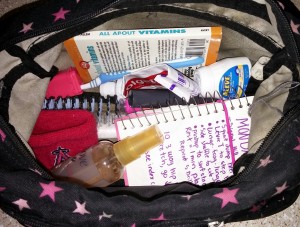
- file under "just in case"

7--Bring your own food (and caffeine!)
Food at these types of events is either free (see tip number 3) or expensive (see tip number 1). Since it's usually a jam-packed day, people don't have time to stand in line for 30 minutes for lunch. The alternative is to bring in your own food. Cuties, RTD protein shakes, baby carrots and pre-sliced apples with nuts or peanut butter are good snacks to bring along because they're small, mess-free and not temperature-dependent. With all the free samples it's probably not necessary to eat a whole 500 calorie lunch. As for the caffeine, well, it's not a necessity for everyone. Some people find caffeine helps if they have to work the booth or walk the floor all day. It also helps some people stay engaged and friendly/peppy when they've got meeting after meeting after meeting.8--Don't look down on those with backpacks.
By the end of the day the free, branded, reusable bag you got at the door is straining with the weight and volume of all the flyers, free pens and samples you've amassed throughout the day. I know it looks silly, but a backpack is not something to scoff at. A backpack is actually a good idea if you have to bring a laptop for some of your convention presentations or meetings, a jacket for layering up in the cold, or a pair of comfy shoes (see tip number 9). Of course there are some exceptions, and some backpacks that should be left at home...
- Little Spark wants to come to the expo

9--Bring comfy shoes (and a pedometer).
Walking the floor is great exercise (but maybe not enough exercise to justify all the free samples you'll consume). You'd be surprised how many miles you walk during events like this so it's a good idea to wear a pedometer. The comfy shoes tip is one many people have already figured out. When I worked the convention center it was always fun to see how the footwear evolved from Day 1 of the expo through to the last day of the event. By the end, everyone is in flats so don't feel bad if you have to trade style for comfort. If anyone makes fun of your kicks, challenge them to a foot race.10--Bring a cell phone charger.
Convention centers don't always get the best reception, and your smart phone may spend its battery power searching for a signal the whole day. Even if the signal was fantastic, battery power dwindles rapidly when you're using the expo app on your smart phone, taking pictures of booths or exhibits, or using GPS to find your way back to your hotel.With these 10 tips, you can avoid common problems and pitfalls of the typical expo or convention. If you have any tips/tricks to add, I'd love to hear them. Thanks, and enjoy the show!
Wednesday, March 5, 2014
Reflecting and Looking Forward -- Big News for the Green-Eyed Guide
Perhaps it’s because my mind works in check lists and bullet points.
Perhaps it’s because I’ve taken on a role that has dramatically improved
my understanding of botanical ingredients and has strengthened my
relationships with ingredient suppliers. Perhaps it’s because I
sometimes make royal messes when I weigh out dry powder ingredients (see
previous post – “The Xanthan Gum Disaster“). For whatever reason, I’ve been promoted from R&D Food Technologist to R&D Quality Assurance Specialist (see “What I Do When I’m Not Blogging“).
I see the projects I’m handed as a reflection of the confidence my team holds in my abilities, and thus the big expectations for me have filled me with excited determination. It reminds me of the first time my mom handed me the keys to the car and said “Okay, you can drive this time.”

I couldn’t be happier, but during this transition I’ve been incredibly busy. I apologize for not posting on a more regular basis but I intend to make up for that. Here’s what lies in store for the month of March:
Like the Facebook page; (here)
I see the projects I’m handed as a reflection of the confidence my team holds in my abilities, and thus the big expectations for me have filled me with excited determination. It reminds me of the first time my mom handed me the keys to the car and said “Okay, you can drive this time.”
I couldn’t be happier, but during this transition I’ve been incredibly busy. I apologize for not posting on a more regular basis but I intend to make up for that. Here’s what lies in store for the month of March:
Upcoming Posts for March on GreenEyedGuide.com:
- Honorable Mentions – products that aren’t quite the caliber for “Energy Drink of the Month” but deserve to be discussed on a scientific basis, for better or worse (one example: “How to Spot a Bad Product“)
- The Linger – A Food Science Horror Story; a continuation of the “Food Scientist Life” series (see other installations of this series here)
- I Ate the Whole Thing – Green-Eyed Insight on what food labels should and could look like with the new FDA guidelines
- Energy Drink/Supplement Dilemmas - What the 2014 FDA guidance and regulations mean for this particular product category (related posts: “Monster Makes the Switch” and “Supplement, Drug or Drink“)
- When Granola Bars Roam Free – Green-Eyed Insight on the most unnatural “natural” food products
Thanks for your support!
Subscribe to this blog and never miss another blog post;
Like the Facebook page; (here)
Read an excerpt of Are You a Monster or a Rock Star: A Guide to Energy Drinks
Monday, February 24, 2014
GMOs, Energy Drinks, and "Natural" Labeling: Controversial Issues Come to Anaheim, CA
On March 6, 2014 the Southern California section of the
Institute of Food Technologists will host the annual "Hot Topics"
conference, featuring discussions on controversial issues including GMOs,
energy drinks and use of the word "natural" on food labels.
This conference is open to anyone in the food/beverage and
supplement industries, from food reporters to restaurant owners; from
ingredient buyers, suppliers and 'marketeers' to food scientists, product
developers and nutritionists. The purpose of this conference is to provide
information on the topics most likely to confront those in the industry:
Should I market my product as an energy drink or a
functional drink? Should we label our product a food or a supplement and what
happens if we pick the wrong category? Can I say this fruit juice is natural?
How can we tell our consumers we just can't do non-GM products without changing
our entire business model and supply chain?
Scheduled Speakers and Topics:
Food/Beverage or Supplement? Guidelines and
watch-outs for marketing in either category
Justin Prochnow, Attorney/Shareholder with Greenberg Traurig, LLP
Biotechnology: How different companies are
handling the issue and how to address the issue with your consumers
John Ruff, Former IFT Chair, and Connor
Link, Sr. Digital/Social Media Editor for New Hope Naturals Media
Satiety, A Balancing Act: Hunger, satiety and the
role of taste and smell in food preference
Dr. Richard Mattes, Distinguished Professor
of Nutrition, Purdue University
The 'Natural' Perspective: What this term means to
industry and to consumers
Catherine Adams Hutt, PhD, RD, Chief Science
& Regulatory Officer, Sloan Trends
The Southern California Food Industry
Conference (SCFIC) will be held at the Anaheim Convention Center Marriott on
March 6, 2014 from 8:30am – 4pm. Winners of the SCFIC Gluten-Free Product
Development Student Competition will be announced and awarded during lunch. For
More Information: http://www.scifts.net/html/scfic.html
Monday, February 17, 2014
Stability Studies May Lead to Instability - Food Scientist Life
This is a series of posts in which I share snippets of what it's like to be a food scientist. As a product developer for dry powder shakes, there are some lessons I never learned in school and some challenges I never saw coming.
Green-Eyed Insight on Stability Studies
Have you ever looked at an expiration date and wondered,
"How do they know?" Determining or confirming the shelf-life of a
product is important for several reasons, but the process itself can be a bit
mind-numbing. Here's what I didn't learn in school.
Why It's Important
Expiration dates are based on the answers to several
different questions. When does the product become unpalatable? When do the
vitamins and minerals degrade below the amounts on the label? When does the
product become unsafe to eat? To sell a product that meets consumer sensory
expectations, label claims and food safety requirements, you have to know the
answers to all three questions.
Side-note: Why It's Confusing
This would be a great time to note that expiration dates can
be perplexing. An expiration date is not quite the same as the "sell
by", "use by" or "best by" date. For example, "use
by" is meant to help consumers know when a product is no longer good to
eat whereas "best by" and "sell by" are meant to help those
selling the product manage their stock (think of those racks of discounted
"Manager's Special" items in back of the grocery store).
Misinterpretation of these dates leads to as much as $165 billion in food waste
PER YEAR according to a report by
the Harvard Food Law and Policy Clinic and the National Resources Defense
Council [1, 2].
Why It's Complicated
As a product developer, I work on a dry powder shake that's supposed to last one year. Our products don't use the "best
by" or "use by" terms; our packages say "EXP
MM/DD/YYYY". Up until that date, our product is expected to taste as
delicious as the day it was made, and must provide all the vitamins/mineral and
nutrient contents on the label. This is harder than it seems because flavors,
proteins, vitamins/minerals and oxidation-prone (air-sensitive) ingredients
like fish oil, chia and flax all have different rates of degradation. In some
cases, products start out with vitamin/mineral overages so there's enough left
at the end of shelf-life to meet the label claims. Instead of using overages,
you might shorten the shelf-life or slow the degradation of certain nutrients with
encapsulation [3].
How We Do It Here
In order to continuously improve the food safety and quality
of our finished product, my team and I are always looking at alternate
ingredients. For example, say blueberry powder A is great, but blueberry powder
B is cheaper and has lower heavy metal contents. We can't just switch from one
to another; what if blueberry powder B makes the product taste funny after 6
months? Our product is supposed to be delicious and nutritious for a whole
year. We've got to test this.
 |
| 500 servings x 35g each x 4 variants |
Step One: Make your blends.
For your control and all your variants you need to make a big enough batch to put a few servings into the freezer ("time
zero"), a few servings into room temperature storage, and a few servings into
accelerated storage (where 1 week at 40* Celsius is equivalent to 2 months at
room temp). Accelerated storage is a marvelous tool because it only takes six
weeks to determine how the product will taste after one year in real time. Plus,
since my office is always freezing cold, I rather enjoy fetching samples from
accelerated storage and feeling the hot air hit my face.
 | ||||
| break big tasks into small steps |
Step Two: Divvy your blends up into single pouches.
Warning
– this may take a while, depending on the size of your batches and number of
variants. Unless you have Audible or music or some metaphysical question to
ponder you may feel your mind slipping a little. Fight the urge to listen to
podcasts because you need to pay attention to what you're doing. I swore off
listening to Baseball Tonight and "Wait Wait …Don't Tell Me" because
once I lost track of what sample I was working on and had to start
over. Rookie mistake.
Step Three: Seal your pouches.
Make darn sure they're
sealed. There's nothing worse than putting all the time and energy into
preparing samples then seeing random powder piles on the shelves inside the
stability chamber.
 |
| Plastic bags and small boxes come in handy! |
Step Four: Set calendar reminders.
Include specifics on what
samples to pull, from what location (freezer, room temp, accelerated) on which
days. Even though you've put all this work into setting up the stability study,
it's not uncommon to set it and forget it. Putting the samples in the Hot Box
mentally feels like the job is done – no more Open Loops. Since one week in the
40*C chamber is the equivalent of two months, it's important not to miss the
days you're supposed to pull a sample.
Step Five: Taste.
This might be a mentally exhausting
exercise based on the number of samples you have to pull. Unlike Pavlov's
dogs you might grow to dread the sound of the calendar reminder, especially if there's a lot of samples or if
they're not aging well. This is where oyster crackers and carbonated water
come in handy – see previous post.

Bottom Line
Shelf-life and stability studies can be mind-numbing, tedious, time-consuming experiments, but you'll learn more about your ingredients and your product than you could possibly anticipate. It's kind of exciting to have that knowledge that others aren't privy to, and that knowledge improves your product and your skill set as a product developer. That is the silver lining.
Resources:
[1] Food Business News: "Expiration harmonization
sought" http://www.foodbusinessnews.net/articles/news_home/Regulatory_News/2013/09/Expiration_harmonization_sough.aspx?ID={85A33A75-6C9E-4D85-9797-34E4874E27D3}
[2] NRDC: "The Dating Game: How Confusing Food Date
Labels Lead to Food Waste in America" http://www.nrdc.org/food/expiration-dates.asp
[3] Maxx Performance Newsletter – Winter 2014 http://email.maxxperform.com/t/ViewEmail/y/B1F4EE53EC2CEA20
Related Posts:
Next Lesson - "The Linger": A Food Science Horror Story
___________________________________________________
Stay tuned for more lessons from the lab.
Follow GreenEyedGuide on Twitter
Friday, February 7, 2014
Energy Drink of the Month - February 2014
Many people have a love/hate relationship with February.
Maybe you're happy there are so many three-day weekends in February or maybe
you feel like it's harder to meet your monthly deadlines because the month is
so short. Perhaps you're looking forward to receiving something cute and fluffy
on Valentine's Day, or perhaps you're excited about that pint of Half-Baked on
Singles Awareness Day. Whether you like it or not, love is in the air, and I
love this month's energy drink.
 |
| How cute is this? It squeaks too! |
Subscribe to:
Posts (Atom)